
Posture isn’t really about how you look sitting at a desk or standing in a photo. It’s a window into how your spine is functioning, and your spine is where your nervous system does a lot of its work. That’s worth thinking about right now especially, with backpacks, new desks, and hours of screen time about to become part of daily life again for a lot of families.
The Posture-Spine Connection
Your spine has natural curves that act like shock absorbers, protecting your nervous system and letting your body move efficiently. When those curves shift, whether from sitting too long, hunching over a phone or laptop, or carrying a backpack that’s heavier than it should be, it adds stress to the joints, muscles, and ligaments around the spine. It can also affect how well the nervous system running through it is able to adapt and communicate.
That second part is the piece that often gets left out. A spine under sustained postural stress isn’t just a mechanical problem. It’s also a nervous system working harder than it needs to, which is part of why posture issues so often show up as more than soreness: fatigue, tension, even mood and focus, in kids and adults alike.
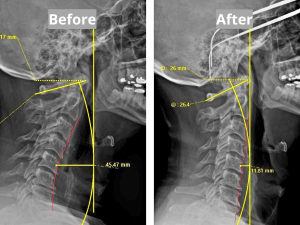
At Cadence, we look at posture through both lenses at once. We use thermography, postural X-ray, and motion X-ray to see specifically where and how a spine has shifted out of alignment, not just that “something’s off,” and we look at those findings alongside how the nervous system is functioning. Restoring alignment matters because of what it does for function and adaptability, not because there’s one “correct” posture to hold.
Why It Matters More As School Starts
A new school year often means longer stretches at a desk, more screen time for homework, and a backpack that’s suddenly part of the daily routine again. None of that is dramatic on its own, but bodies (especially still-developing ones) adapt to whatever they’re asked to do most. A few weeks of a heavy backpack worn the same way every day, or hours hunched toward a screen, can start to become the pattern a spine defaults to.
Breathing changes too. A hunched posture compresses the ribcage and limits lung capacity, and breathing itself is closely tied to nervous system regulation, something that matters as much during a stressful homework night as it does anywhere else. And posture affects energy: slouched positioning means muscles work harder just to stay upright, which adds up to real fatigue by the end of a long school day.
How Chiropractic Helps
Chiropractic care addresses where posture is actually shifting, rather than just reminding someone to sit up straight. Postural and motion X-rays work together to show us where to focus: postural X-rays reveal where the spine has shifted, while motion X-rays show us how well each area is actually moving, since a segment can be restricted even when it hasn’t visibly shifted. Adjustments are built around both of those pictures, not a generic protocol, for kids and adults.
Alongside adjustments, we often recommend targeted exercises, practical changes like backpack fit or desk setup, contrast therapy for circulation and recovery, and community education through workshops here in Eden Prairie.
Small Steps, Big Changes
You don’t need to overhaul a whole routine at once. Checking a phone or tablet at eye level instead of looking down, building in short movement breaks between homework subjects, and paying attention to how a backpack actually sits (both straps, weight close to the body) are all small, manageable starting points.
Combined with chiropractic care, small, consistent changes like these tend to add up to more than people expect, whether the school year is just starting or already well underway.
If you’ve been curious about what’s actually going on with your child’s posture, or your own, we’re happy to walk through it with you. We’ll look at what the spine and nervous system are telling us and build a plan from there.
#MotionIsLife #CadenceChiroMN
